
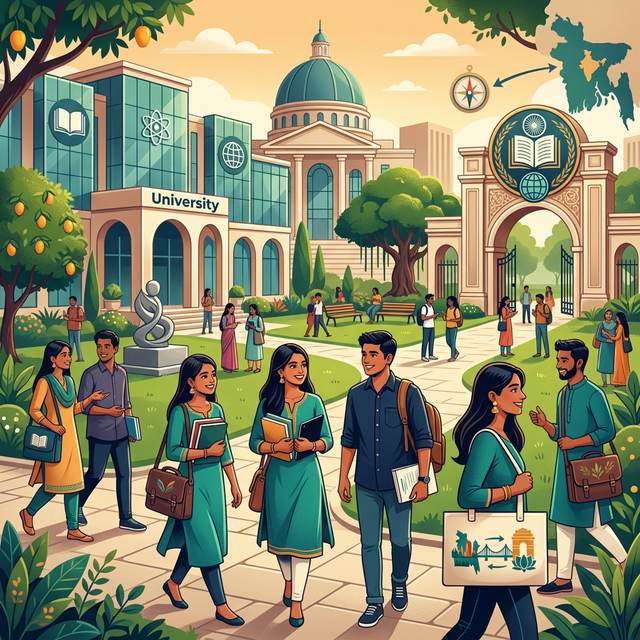
India continues to be one of the most accessible and credential-strong study destinations for Bangladeshi students. In 2026, the combination of scholarship availability, program diversity, and geographic proximity makes India a genuinely competitive option — not simply a fallback.
This guide is for students and families who are still deciding whether India is the right move. It covers what actually affects the decision: cost, scholarships, program fit, and the practical steps from inquiry to arrival.
Is India right for you?
The decision to study in India comes down to three questions:
- Can you afford the realistic annual cost — tuition after scholarship, hostel, admission fees, and travel?
- Is the program you want available at adequate quality in Indian private universities?
- Are you prepared for the adjustment — language, environment, campus life, and distance from family?
For students in Northern Bangladesh, India scores well on all three if the university and program are chosen carefully. The challenge is making that choice accurately rather than going by name recognition alone.
What India offers that other destinations struggle to match
Scholarship-adjusted affordability. Most Indian private universities offer scholarship tiers for Bangladeshi students that can reduce tuition by 20–60%. When combined with India’s relatively lower cost of living compared to Western destinations, the total annual cost can be significantly more manageable.
Program breadth. Engineering, business administration, law, nursing, allied health, pharmacy, design, computer applications, and the sciences are all widely available. A student does not need to narrow down to a single specialised institution.
Duration and recognition. Indian degrees follow a structured 3–4 year format. Universities approved by UGC and accredited by NAAC (National Assessment and Accreditation Council) or graded by NIRF are recognised internationally.
Proximity and family comfort. For families in Dinajpur and Rangpur, India is reachable in a day. This matters for family confidence, visits, and emergencies.
Understanding the real cost
The most common mistake students make is treating scholarship percentage as the total cost indicator. It is not.
A typical annual cost breakdown includes:
- Tuition after scholarship — varies by university and program, typically INR 60,000–1,50,000 per year after discount
- Admission and registration fees — one-time payment at the start, often INR 40,000–80,000
- Hostel and mess (food) — INR 60,000–1,20,000 per year depending on room type
- Exam and university fees — INR 10,000–25,000 per year
- Travel — two trips per year at minimum from Bangladesh to India
When these are added together, many students find the real annual figure is higher than the tuition-only number they initially compared.
WBE builds this full breakdown before recommending any university.
Programs Bangladeshi students most commonly pursue
The most popular program choices for Bangladeshi students in India are:
- B.Tech (Engineering) — Computer Science, Mechanical, Civil, Electronics
- BBA / MBA — Business administration and management programs
- BCA / MCA — Computer applications and IT-focused degrees
- MBBS — Medical degree (longer intake process, separate scholarship structure)
- B.Sc Nursing / Paramedical — Allied health programs are strong at several partner universities
- LLB — Law programs available at university law schools
- B.Sc / B.Tech Biotechnology, Food Technology — Science-based options with scholarship
Choosing the right university
Three factors should drive university choice:
1. Program quality and outcome. Does the university have a strong department for the chosen subject? What are placement outcomes? Is the university approved by UGC and accredited?
2. Scholarship reality. What is the maximum scholarship available for the specific program? What are the GPA conditions? Is the scholarship renewable?
3. Total annual cost. What does a student actually pay after applying the scholarship, including all fees and hostel?
Name recognition is not a reliable indicator on its own. Some of the most recognisable names in Indian private education carry the highest total costs once all fees are counted.
The WBE process in 2025
WBE handles the admission process end-to-end:
- Profile review and counselling
- University shortlist with full cost breakdown
- Document check and preparation
- Application submission and offer letter coordination
- Visa guidance and pre-departure orientation
- Post-arrival support and follow-up
There is no charge to the student at any stage. WBE operates on a zero-service-fee model.
Next steps
If you are currently researching India options, the best starting point is a direct conversation with WBE — by WhatsApp, phone, or in person. Bring your SSC and HSC results, your preferred program area, and a rough budget range. That is enough to get a useful first recommendation.